
Compton City Directory Collections
The known Compton city directory holdings are useful precisely because they are not a smooth annual run. LAPL's City Directories Index brings together Compton, Watts, and Los Angeles City and County catalog paths. The table gives a working coverage map. Exact publishers and some issue-level details still need title-page confirmation at the holding library.
| Collection | Years | Where held | Access |
|---|---|---|---|
| Compton/Watts 35mm | 1913-16; 1921-23; 1925; 1927-28; 1931; 1940; 1946-47; 1949; 1951 | LAPL Central History and Genealogy | Microfilm |
| Compton 16mm roll 30 | 1949, 1962 | LAPL microfiche drawers, NH 973.03 C5815 | Microfilm reader |
| Rolls 102-103 | 1921, 1922, 1925, 1931, 1932, 1936, 1940, 1946, 1948, 1954, 1957 | LAPL roll-number holdings | Request by roll |
| Paper issues | 1884-85; 1931; 1957/58; 1962 | LAPL catalog paths | Paper, catalog varies |
| Digitized regional issues | Los Angeles 1881-82 through 1887-88; Watts 1914-15, 1919, 1921, 1925 | LAPL index and digital links | Online search where available |
The date gaps are part of the research result. A missing year should lead to another shelf label, a newspaper search, or a librarian question, not a claim that a household moved.
Note: The LAPL holdings are a scattered coverage map, so a missing Compton year should trigger another catalog label or a librarian request.
Compton Library's City Directory Shelf
Compton Library opened in July 1913 as the eleventh Los Angeles County Library branch. It first occupied a storefront near Main and Tamarind, then Compton Union High School at 212 South Acacia, a 1925 building at 123 West Almond, and the current Compton Boulevard facility dating from 1974. Those moves are more than institutional trivia. A newspaper notice or directory reference may use a former library anchor, school location, or neighborhood name.
The branch at 240 West Compton Boulevard offers research help, public computers, law-library database access, and newspapers. Listed hours are Tuesday and Wednesday noon to 8, Thursday through Saturday 10 to 6, and closed Sunday and Monday. The newspaper list includes the Los Angeles Sentinel, Los Angeles Wave, Los Angeles Times, LA Watts Times, and Long Beach Press-Telegram. Those papers can fill an obituary, civic notice, address, or community event gap in a dated volume.
The Compton Library local-history page is the practical branch contact for a directory search that needs staff help or newspaper access.
The CSUDH South Bay Digital Collection supplies image context for Compton city directory research and local-history work.
Local history images and notices can supply the place context that a bare directory line leaves out.
Search Compton City Directories Under Watts
Compton hides under Watts for many early directory runs. The 1913-1928 catalog pattern is the key warning. A search limited to the word Compton can miss a name that appears under Watts, while an 1884-85 volume may be shelved under Los Angeles City and County. The catalog label is a finding aid, not proof that the address belonged to another town.
Search city or community, county, state, and region fields in the LAPL City Directories Index. Its controls accept optional text, AND, OR, and NOT selectors, and an asterisk can truncate a word. Try the person's surname, a street fragment, Compton, Watts, Los Angeles, and older place names. Keep a note of the exact volume title because a 1951 publisher attribution still needs title-page verification.
The LAPL City Directories Index is the first catalog route for the regional directory shelf. It helps locate a run; it does not promise that every issue has survived or that every scan is searchable.
Read a Compton City Directory Entry
Begin with the title page and abbreviation key. A printed Compton entry may contain a surname, given name or initial, spouse, occupation or work affiliation, residence mark, street number and name, telephone, widow notation, and a cross-reference. The marks `h`, `r`, or `b` may appear, but their meaning must be checked in that volume's key. Some books mix alphabetical residents, street or reverse pages, telephone listings, buyers' guides, and classified material.
| Entry field | What it can tell you |
|---|---|
| Name and initial | Index spelling and possible same-name variants |
| Spouse or widow mark | Family clue to compare with newspapers |
| Occupation or work affiliation | Identity anchor for the year, not a present fact |
| Residence mark and street | Home or address line as printed |
| Phone and cross-reference | Contact or alternate entry path |
- Criss-cross directory
- A reverse edition that starts with a street address and may lead to an adult occupant.
- Householder index
- A name or household-focused arrangement that may differ from a street listing.
- Abbreviation key
- The volume's own explanation of residence, occupation, and relationship marks.
Do not copy a line without its year and page. A directory is an index artifact. The spelling, address, and occupation should be compared with a second volume or a dated newspaper before identity is treated as settled.
Note: A directory entry is evidence for its printed year; later status requires a separate record with its own custodian and access rules.
Trace Compton City Directory Names
A household trail works best as a short, dated sequence. Start with a known 1962 or 1957/58 entry, then compare 1954, 1951, 1949, 1948, 1946-47, and 1940 where the shelf holds them. Move earlier through Watts or Los Angeles titles when Compton disappears from the catalog. Record the address exactly as printed, then normalize it in a separate note.
- Photograph or transcribe the title page, volume year, page, and abbreviation key.
- Find the name in the alphabetical section and check a street or reverse section if present.
- Compare spouse, occupation, phone, and neighboring address clues with the next known year.
- Pair the directory line with a public federal census through 1950, a newspaper, or an obituary.
- Flag gaps and alternate catalog labels instead of treating silence as a move.
The modern parcel trail belongs to the Compton street directory when an older address needs an AIN or current map match. The historical city directory remains the source for how the household appeared in print.
Compton Directory Clues in Black Press
The A C Bilbrew Black Resource Center at 150 East El Segundo Boulevard provides a microfilm reader and scanner and holds the Compton Bulletin, Los Angeles Sentinel, California Eagle, LA Watts Times, Our Weekly, and Wave, along with NAACP papers and community ephemera. These materials can reveal obituaries, civic meetings, school notes, business openings, and addresses that never enter a formal directory.
The Compton Bulletin is especially valuable for a local name search because it sits closer to the neighborhood record than a broad regional directory. Search a known surname with a street, church, school, business, or date. Confirm an address against a directory or parcel record and keep the newspaper citation. An obituary can identify relatives and a last known place, but it does not prove that every listed person lived together.
The Black Resource Center holdings page identifies the research path for Compton's Black press and microform material.
CSUDH's South Bay Digital Collection adds photographs, letters, businesses, settlers, earthquake damage, and rebuilding images that can help explain a directory address.
Compton Directory Addresses Through 1933
Compton's 1933 earthquake creates a useful before-and-after research question. Compare the 1931 or 1932 directory with the next known 1936 issue, then check local photographs, permits, or newspaper notices. A changed address may reflect rebuilding, a missing volume, a street-text shift, or an ordinary move. The earthquake is context, not proof of why an entry changed.
The older place vocabulary matters too. Compton was incorporated on May 11, 1888, while earlier catalogs place the community inside Los Angeles City and County or Watts. Wilmington Avenue later became Willowbrook Avenue. A directory line using Wilmington should be compared with intersections, tract and lot, and modern parcel geography before it is discarded.
That combination of event, place name, and catalog label makes a Compton historical directory more than a list of names. It becomes a dated source that can be tested against the rest of the local record trail.
Digitized Compton Directory Catalogs
Digitized material is helpful but uneven. LAPL lists Los Angeles issues from 1881-82 through 1887-88 and Watts issues from 1914-15, 1919, 1921, and 1925. A FamilySearch Compton catalog search can point to historical holdings, although catalog access and image availability vary by account, place label, and item. A search result is not the same as a public scan.
Use the digital path to test a surname or street spelling, then write down the title and page. If an item is restricted or absent online, take the citation to LAPL Central History and Genealogy, Compton Library, LA County Library Californiana at Norwalk, or an institutional archive. The exact surviving first and last printed years remain a research gap, and the sources do not support calling the run continuous.
The FamilySearch Compton catalog is a discovery aid, while the LAPL index supplies the most specific known roll map.
The LAPL directory index supplies the catalog-first workflow for Compton city directory research.
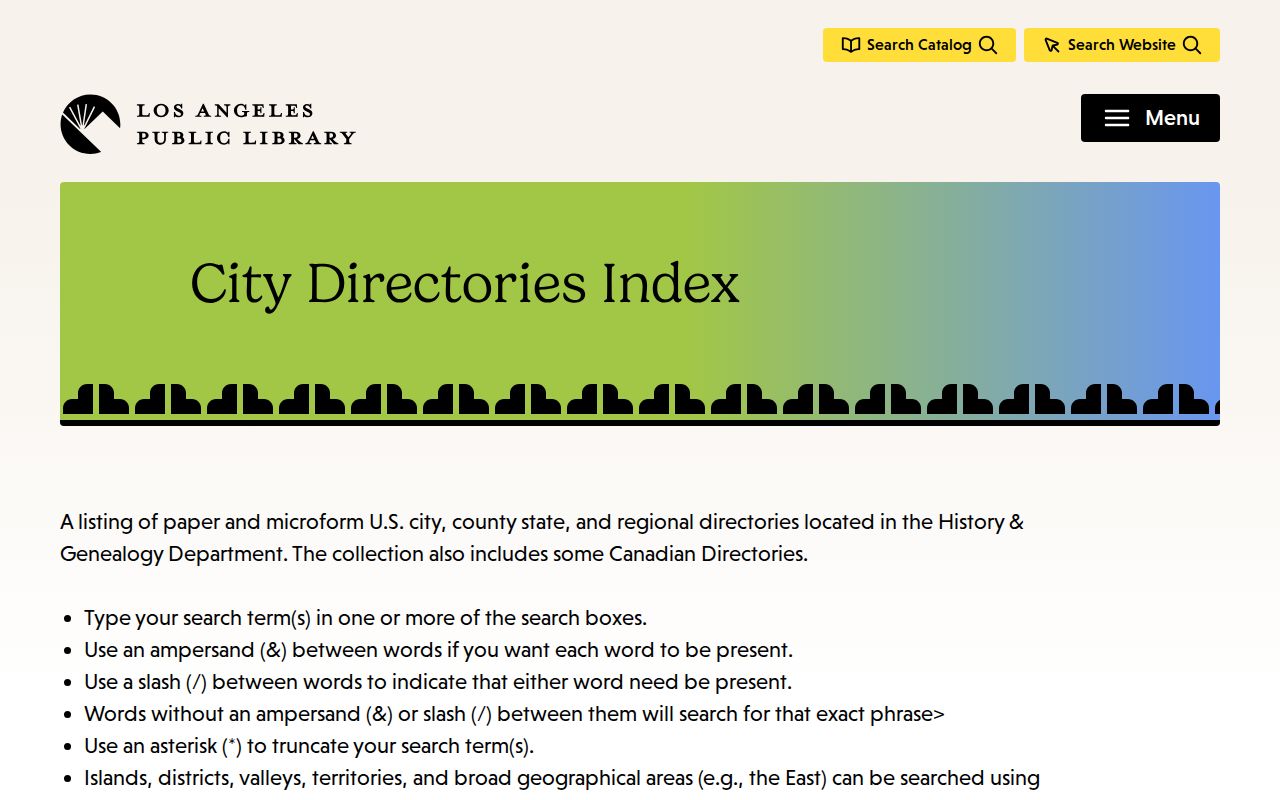
The index view helps a researcher choose a city, year, and holding before traveling to a reader or requesting staff help.
Note: A digital catalog hit can identify a holding without providing an unrestricted scan, readable page, or complete annual run.
When Compton Directory Runs Are Unclear
Several facts should remain explicit. A 1951 publisher may be Pacific Directory Company, but the title page still needs checking. Exact other publishers are not verified. Sanborn maps can show footprints, materials, uses, streets, and house numbers, but a standalone Compton edition and year run were not confirmed in the official catalog. No broad WPA index was verified.
These gaps do not make the city directory useless. They tell the researcher where to ask a librarian, search a neighboring catalog label, or use a newspaper and parcel source as a check. A careful citation says “held for this year” rather than claiming a complete series.
The Library of Congress Sanborn collection explains what map sheets can show, while local libraries determine whether a Compton sheet is actually held.
Using Compton City Directories for Family History
Family history is where the Compton city directory earns its strongest use. A printed line can connect a surname to a street, spouse, occupation, phone, church notice, or neighborhood in a particular year. It can help reconnect classmates, identify a grandparent's address, or frame an obituary search without pretending that one entry is a complete census.
Begin with a full name and an approximate decade. Search spelling variants, initials, married or widowed forms, and both surname orders when the source suggests them. Write down the catalog label, volume year, page, and exact entry. Then compare one earlier and one later year, a newspaper or obituary, and the federal census through 1950. Address text may need a Willowbrook or Watts cross-check.
A current identity question belongs in the Compton resident lookup workflow once a historical name needs present-day verification. The city directory remains the historical evidence, not a current roster.
Note: A city directory can place a person in a dated publication, but only the custodian of another record can confirm that record's present status.