
Finding Who Lives on a Compton Street
A useful address walk starts with the exact location and ends with a set of records that agree on place and time. The online parcel step comes first because Los Angeles County does not offer a public owner-name search on its assessor website, and the recorder has no address search. The result is a chain, not a single answer.
- Enter the full street address in the Los Angeles County Assessor Portal, choose the matching suggestion, and save the AIN and legal description.
- Open the parcel map and click nearby shapes in a slow street-by-street walk, recording each AIN and situs address.
- Use an authorized assessor counter or data channel for owner information, keeping mailing address separate from situs.
- Search the RR/CC grantor and grantee indexes by name and likely year when a deed trail is needed.
- Use the voter status form only for personal verification and use historical reverse directories for past occupants.
That sequence answers who owns a parcel before it suggests who may have occupied it. An address result becomes stronger when a date, legal description, or second record anchors the name.
Compton Street Address to AIN
The AIN is the stable key in the Compton address trail. It ties the assessor card to the map, tax account, legal description, and later record requests. Search the address in the assessor's Basic Search field, accept the closest map suggestion, and check whether the situs line matches the place you intend. A corner parcel, apartment property, commercial lot, new development, or vacant parcel may need cross streets instead of a perfect street string.
The public card may show use type, building characteristics, year built, unit or square-foot data, assessed land and improvement values, tax-rate area, and sale history. It deliberately omits the owner name and owner mailing address. Owner data is available through an assessor office or Property Data Sales, subject to county rules. Save the legal description too. Tract, lot, and block language can bridge an old address when street text no longer matches.
The assessor help page describes VAC and VIC as proximity notation for a vacant parcel. The label is a search clue, not a conventional address. A displayed sale amount based on documentary transfer tax may carry copied leading digits that signal a conversion, so treat it as a data convention rather than a fresh appraisal.
The Assessor mapping help is the best place to check these address quirks before building a parcel list.
The Assessor mapping help anchors Compton street research because every later street step depends on a sound AIN.
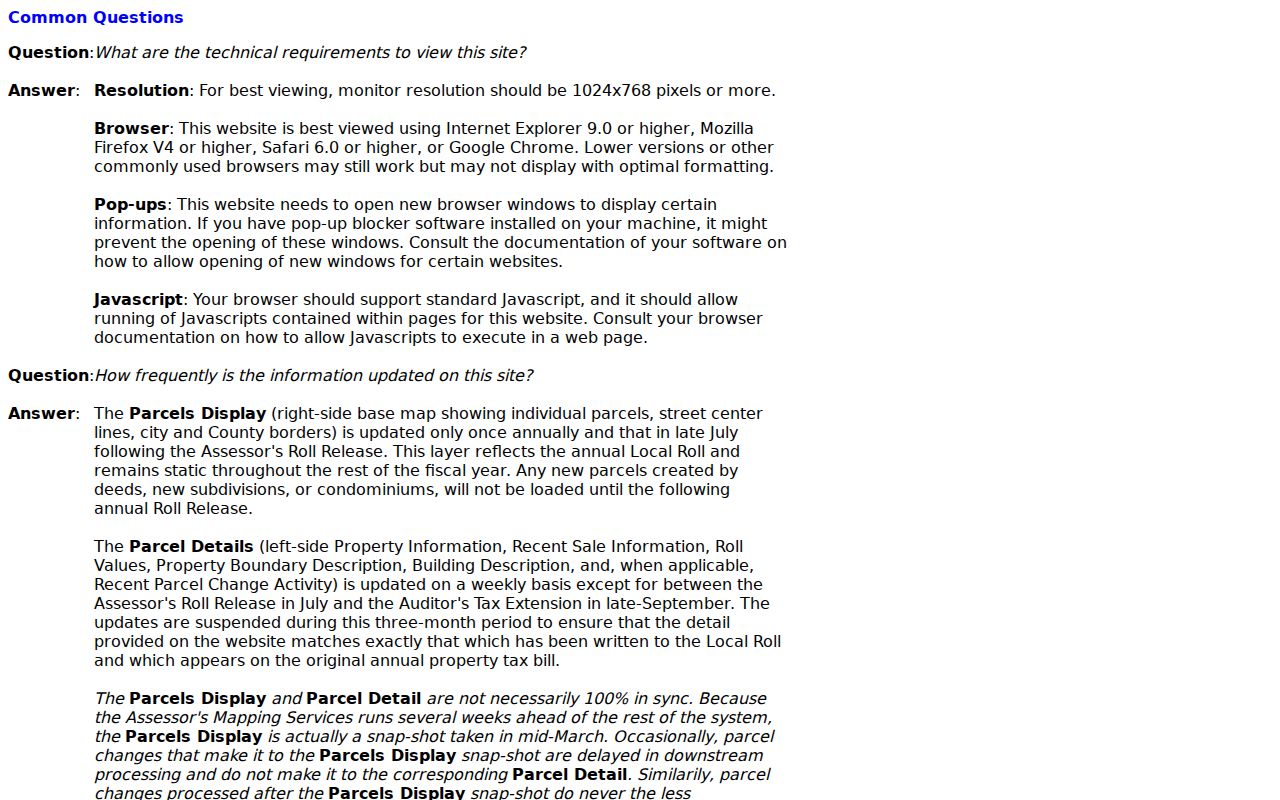
The public map begins with an address or AIN, then lets the researcher preserve parcel context for the next office.
Note: An AIN is a parcel key, not an occupancy record, so the street directory must keep ownership, situs, and household evidence separate.
Browse Compton Street Parcels on GIS-NET
GIS-NET adds a map-first view to the Compton street-by-street search. Its public guide describes an APN text search and an address text search with city or ZIP, plus tool tabs, an information panel, an “I want to...” menu, basemap controls, and parcel selection. Search a known address, zoom until lot lines are clear, and click adjacent polygons in a clockwise order. If an automatic buffer is not available, a manual parcel walk is more repeatable than a vague radius.
| GIS control | Input or action | Street use |
|---|---|---|
| APN | Parcel number text | Open a known parcel |
| Address | Address with city or ZIP | Resolve a street location |
| Search | Run the chosen query | Load map results |
| Tool Tabs | Map and query functions | Change the research view |
| Basemap switcher | Aerial or other base layers | Read physical context |
| Parcel click | Select a visible polygon | Record nearby AINs |
County GIS supplies parcel context, but incorporated Compton zoning and planning decisions remain city matters. A map can show a boundary, not a person. Owner identity is not reliably exposed in the public viewer.
The GIS-NET public quick-start guide documents the APN and address controls used to browse a Compton block.
Compton Records Searchable by Street
Address-keyed records form the working spine of a Compton street directory. Each source has a distinct claim. The assessor supplies parcel facts. GIS supplies shape and nearby AINs. RR/CC supplies recorded parties after a name and year are known. City permits show work tied to an address. Voter information is identity-gated and cannot be used as a street browser.
| Record set | Keeper | What it shows | Access |
|---|---|---|---|
| Parcel roll and map | LA County Assessor | AIN, situs, legal and property facts | Free address/AIN portal |
| Parcel geometry | Assessor and GIS-NET | Boundaries and nearby parcels | Free map viewer |
| Deeds and liens | RR/CC Recorder | Parties, dates, instruments, past title | Norwalk name/year index |
| Permits and code cases | Compton departments | Projects, participants, dates, dispositions | Portal, counter, or CPRA |
| Voter data | LA County RR/CC | Authorized registration fields | Identity form or restricted request |
The AIN connects the parcel roll to the map and tax account. The legal description connects the parcel to a deed. The address connects a permit or city case to a place. The name-and-year index connects a deed to a party. Keeping those links in separate columns makes the street directory auditable.
Note: Each Compton record keeper answers a different question, so an address match should never be presented as a complete household list.
Compton Street Address Terms
A situs address is the physical taxable location. A mailing address is where tax correspondence goes. A legal description names the tract, lot, or block used in a recorded instrument. These three identifiers can point in different directions, especially when a parcel has an off-site owner, a corner location, several units, or an older street label.
- Parcel
- A mapped unit of land tied to an AIN and legal description.
- Situs address
- The physical location used to identify the taxable property.
- Plat
- A recorded map that lays out lots, blocks, streets, and tract lines.
- Criss-cross directory
- A reverse directory that starts with an address and may list an adult occupant or phone entry.
Use situs for map and permit work. Use mailing address only as a contact clue. Use the legal description when an old deed or directory uses Wilmington Avenue, a different house number, or an unfamiliar tract name. The distinction prevents a street directory from turning a tax record into an unsupported claim about a household.
Trace Compton Parcels Through Norwalk
The RR/CC deed trail is name-first. Los Angeles County's Recorder Division preserves real-property records from 1850 or 1851, but the alphabetical grantor and grantee indexes must be viewed by appointment at Norwalk. Records dated 1851-1957 are on the lower level; 1958-present are on the second floor. Telephone index searches are not accepted.
Start with a current owner name obtained through an authorized assessor channel. Search that name as grantee near the likely acquisition year. Note the instrument number, date, and legal description. Read the deed's grantor, then search that seller as an earlier grantee. Repeat only while the tract and lot remain the same. Same-name parties and multiple parcels can create false branches.
The RR/CC recorder FAQ explains the grantor, grantee, year, and no-address search limits. Once a document is identified, the mail request route and fee schedule cover a plain or certified copy, but a copy order cannot recreate an unknown-name search.
The county recorder FAQ is the source linked to the appointment route.
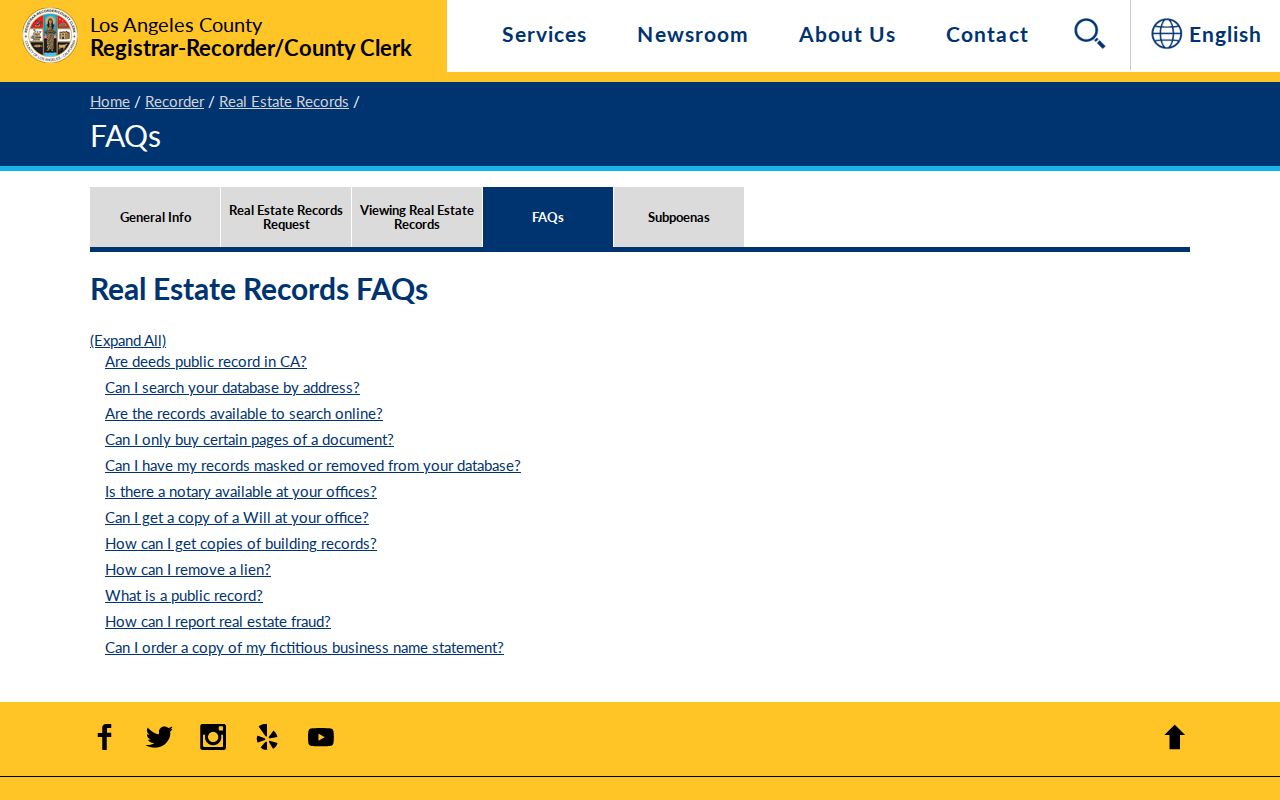
The offline index is a limitation, but it also preserves a long title trail once the parcel and name are known.
Compton Lots and Tracts Beat Street Text
Modern address text can fail when a street was renamed, a parcel sits on a corner, or a house number changed. Compton's incorporation history gives one important bridge: Wilmington Avenue became Willowbrook Avenue. An older directory or deed using Wilmington may still describe a parcel that appears under Willowbrook today. Compare intersections, tract and lot language, map position, and AIN before deciding that a record belongs elsewhere.
Legal descriptions are not the same as a street label. A tract, lot, and block can stay stable while a postal line changes. The old description may also make a title chain easier to follow than a loosely typed address. Save both the original wording and the modern normalized form in notes.
Los Angeles County GIS provides map context, while Compton Planning and Building and Safety are the proper city contacts for zoning or assigned-address questions. A county map does not make an unincorporated Willowbrook parcel a Compton City record.
Compton Permits by Address
Building and Safety records add a time layer to the street directory. Compton issues permits for new construction, alteration, repair, and improvement, reviews plans, performs inspections, issues certificates of occupancy, and handles unsafe-property abatement. Citizenserve is the online gateway, but the research did not find a stable public historical search or a declared coverage year. An account or a city request may be needed.
The residential presale report is especially useful. Under Municipal Code section 14-2.3, it covers authorized use, occupancy, zoning classification, and recorded code matters before a sale or exchange. The City says records can be reviewed by appointment or public-record request. The cited minimum inspection fees were $129 for a single-family dwelling and $105 per multifamily unit; check the current schedule.
A permit name is tied to a project. It may identify an owner, applicant, contractor, or designer, but it does not prove that the named person lived at the address. Use the exact AIN and address in a CPRA request when a public portal does not show the needed history.
The Compton Citizenserve portal is the city entry point for permit and inspection services.
The broader Compton Building and Safety page describes the department's permit and inspection functions before a street request is sent.
Note: A permit participant is tied to a project, not automatically to household occupancy at the Compton address.
Reverse Directories for Compton Occupants
Ownership and occupancy split apart in a street directory. Historical reverse or criss-cross directories can move from an address to an adult occupant, phone entry, occupation, or household notation. LAPL's known Compton and Watts runs are scattered from 1913 through 1962, with earlier Los Angeles City and County material and digitized Watts titles. Exact editions and publishers need catalog or title-page checks.
Start with the closest known year, inspect the abbreviation key, and record whether the volume is alphabetical, street-based, telephone, classified, or a buyer's guide. Then compare a neighboring year. A missing listing can mean a gap in the collection, an address change, a different catalog label, or an ordinary move. Pair the directory with newspapers, obituaries, or the 1950 census when the dates fit.
The historical collection itself is detailed on the Compton city directory collections page. The street directory uses it only for the occupant layer after the modern parcel chain is clear.
Voter Data Is Not a Street Browser
The LA County voter status form requires last name, birthdate, residence house number, and ZIP Code. It is a personal verification tool. It is not a public street directory and it cannot be used to browse every registration around an address. Elections Code sections 2188 and 2194 limit access, disclosure, publication, marketing, and private or harassing use.
A qualified voter-file request requires requester and beneficiary details, organization, purpose, geography, history or district fields, storage and security terms, and a declaration under penalty of perjury. Statewide specific-voter requests have separate limits and fees. Safe at Home and other protections can suppress an address.
That restriction protects the difference between an authorized identity check and a published list of neighbors. A blank result is not proof that nobody is connected to a street, and a registration address is not automatic proof of present occupancy.
What a Compton Street Directory Cannot Show
No public source lists every person at a Compton address. Household members, utility customers, short-term visitors, and many private occupants do not appear in deeds or assessor cards. DMV address data is restricted by the federal Driver's Privacy Protection Act and California rules. Protected officials and Safe at Home participants may use substitute addresses.
Lawful use. Address records support family history, civic research, reconnecting, and personal safety awareness. Using a Compton street directory to stalk, harass, intimidate, or harm anyone is unlawful.
A street result should stop at the claim the source supports. If the goal changes from a whole street to one person, use a separate identity workflow that compares dates, case details, AIN, or a verified affiliation.
Note: A protected or private address may be absent from public results, so silence cannot establish that a Compton household is missing.
Which Compton Office Holds the Next Link
The right handoff depends on the next fact needed. The City Clerk handles municipal history and CPRA routing. Building and Safety handles permits, inspections, and presale material. Public Safety handles business-license and code-enforcement contacts. The assessor holds parcel facts and off-web owner access. RR/CC holds recorded documents and the name-and-year index. The library and LAPL hold historical directories and newspapers.
| Need | First office | Channel | Useful key |
|---|---|---|---|
| Parcel location | LA County Assessor | Portal and map | Address or AIN |
| Owner or deed | Assessor, then RR/CC | Counter and Norwalk appointment | Name and year |
| Project history | Compton Building and Safety | Citizenserve, counter, CPRA | Address and AIN |
| Past occupant | LAPL or Compton Library | Microfilm, paper, research help | Name, street, year |
| Election status | LA County RR/CC | Identity-gated form | Last name, DOB, address |
That handoff keeps the Compton street directory specific to address research without pretending that one portal contains the whole record trail.
The Compton City Clerk public-records instructions point to the city request route, the Public Safety page covers business-license and code contacts, the City online-services directory gathers current entry points, and the county's RR/CC Public Records Act request page covers county-held records.