
Looking Up Your Compton Neighbors
The immediate block has several official layers, but no single source shows everyone around a home. Start with the parcel map, then record the nearby AINs and situs addresses. Owner data comes through an assessor counter or data channel. Deeds show recorded parties over time. City files show work or case participants. Voter information is limited to authorized forms and purposes. Council maps show civic geography, not member households.
| Source | What it shows about a block | Access |
|---|---|---|
| Assessor and GIS-NET | Parcel layout, AIN, situs, nearby shapes | Free map; owner name suppressed online |
| Assessor public roll channel | Owner and mailing information subject to limits | Counter or data service |
| RR/CC deeds | Owners and transaction parties over time | Name and year at Norwalk |
| Compton permits and code records | Projects, dates, applicants, case matters | Portal, counter, or CPRA |
| Voter data | Authorized registration fields | Identity form or qualified request |
| Council district maps | Political and community geography | City pages |
A neighbor result should name the source and claim. “Adjacent parcel” is not the same as “current household,” and “owner” is not the same as “occupant.” Compton neighbors may share a block without sharing a record category.
Note: A block table identifies data layers and access, not a census of current Compton neighbors.
Compton Block Parcel Walkthrough
Open the Los Angeles County Assessor Portal with the known street address or AIN. Move to the map, zoom until lot boundaries are clear, and click each polygon that touches or sits near the subject parcel. Record AIN, situs, jurisdiction, and any legal or planning link shown in the information panel.
If a buffer tool is not available, a manual clockwise walk is more reproducible than a vague radius. Use an aerial basemap only for physical context. It cannot identify occupants. One parcel can contain several units, and a mailing address can sit somewhere else.
The GIS-NET public guide describes APN or address search, city or ZIP input, map tabs, the information panel, shortcuts, and basemap controls that support this block method.
The map view anchors a Compton neighbor lookup to physical geography before any name is considered.
Compton Block AIN List
Build a short AIN list before trying to connect people to parcels. For each nearby polygon, save the AIN, situs, legal description, map position, and jurisdiction. AINs generally display in grouped ten-digit form and connect the assessor facts to tax bills and later requests. The public site does not provide owner-name search, so the list prevents a common-name guess from driving the block search.
Owner information comes through an assessor district office or Property Data Sales. Use the same AIN when asking about a city permit or presale report. If a deed trail is needed, research the lawful owner name in RR/CC's grantor and grantee index by year. These are separate steps with separate access rules.
The Assessor map help explains why corner, multiunit, commercial, new, and vacant parcels may need cross streets or map selection. VAC and VIC are proximity marks, not regular address forms.
Note: The AIN list stabilizes parcel research, but it does not create a public owner or occupant list.
Mapping a Compton Block: Parcels and Owners
A block map is a process flow: known address to subject AIN, subject AIN to adjacent polygons, each polygon to owner channel, owner to recorded deed when needed, and parcel to city or community context. The order matters because the assessor map can identify place while the recorder identifies parties only after a name is known.
- Resolve the subject address in the Assessor Portal and save its AIN and legal description.
- Zoom to the block and click every touching or nearby parcel in a consistent direction.
- Keep owner, mailing, situs, and occupant fields in separate notes.
- Use assessor off-web access for owner information, then RR/CC for a name-and-year deed trail.
- Check Compton permits, council district geography, and lawful community contacts for local context.
The full named-street chain belongs to the Compton street directory. The neighbor workflow stops at the immediate block or radius and asks what the map and community layer can honestly show.
Compton Owner, Occupant, and Neighbor Claims
“Owner” is a title or assessor claim. “Occupant” is a dated directory, census, or other presence clue. “Neighbor” is a relationship created by parcel proximity. Those words should not be used as substitutes. A tax bill describes an account. A permit names people tied to work. A deed lists parties to a transaction. A utility account is a private customer record.
- AIN
- The county parcel number used to connect map and assessor information.
- Situs
- The physical location of the taxable parcel.
- Mailing address
- The destination for notices, which may not be the parcel location.
- Adjacent parcel
- A mapped polygon touching or near the subject parcel, not a confirmed household.
Keeping these terms apart makes a block lookup more useful and less intrusive. It also makes it easier to correct a source-specific error.
Compton Block Permit Records
Building and Safety records can explain visible change around a Compton address. The department handles new construction, alteration, repair, improvement, plan review, inspection, certificates of occupancy, and unsafe-property abatement. Citizenserve offers the online gateway, but the research did not find a stable public historical search or exact coverage year.
Compton's presale inspection report under Municipal Code section 14-2.3 covers authorized use, occupancy, zoning classification, and recorded code matters before a sale or exchange. A city FAQ says the report can be reviewed by appointment or public-record request. The research cited minimum inspection fees of $129 for a single-family dwelling and $105 per multifamily unit, subject to confirmation.
A permit record can identify an owner, applicant, contractor, or designer at a date. It cannot turn a project participant into a neighbor or prove that person lived nearby. Use the exact address and AIN in the Compton public-records portal when the public session does not return the needed history.
Note: Permit records explain work near a parcel, while the named people remain tied to the project record.
Compton Block District Maps
Compton's council districts provide a civic layer around the parcel map. District 1 is northwest, District 2 northeast, and Districts 3 and 4 cover the remaining city sectors. City pages publish elected-official and liaison contacts. They help route a question about a public meeting, neighborhood concern, or municipal service, but they do not publish a member household roster.
Use the Compton elected-officials page for district geography and official contacts. A district boundary is not an occupancy list, and the postal ZIP may include land outside the incorporated city.
That distinction gives neighbors a civic entry point without turning a political map into a personal directory. Compton neighbors can use district contacts for public issues without requesting a private roster.
Compton Block Voter Law
LA County's voter status form requires last name, birthdate, residence house number, and ZIP Code. It verifies the entered person's registration status. It cannot browse a block. Elections Code sections 2188 and 2194 restrict voter-file access, personal or private use, marketing, publication, sale, and harassment. Government Code section 7924.000 supplies a related public-record exemption.
A qualified voter-file request needs a permitted purpose, requester and beneficiary information, geography, history or district fields, security and storage terms, and a certification under penalty of perjury. Safe at Home and other confidential voters may use substitute or suppressed addresses. A missing status result is not proof that a home lacks a voter or neighbor.
The LA County voter status page is appropriate for personal verification, not for building a Compton neighbors list.
The LA County voter status lookup shows the identity-gated route used for a lawful Compton neighbor check.
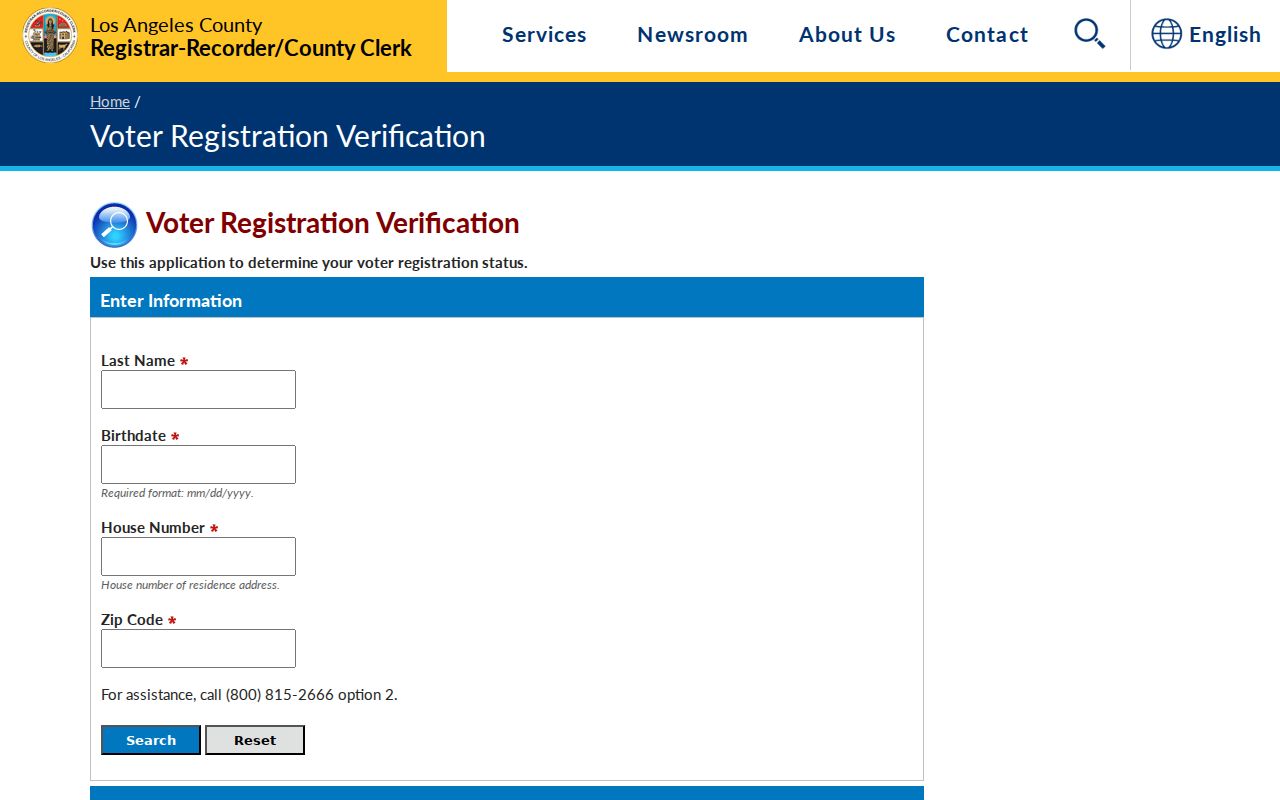
The form's required identity fields explain why it cannot become a public block roster.
Note: Identity-gated voter data can verify an entered person, but it cannot supply a complete block roster.
Compton Block Household Limits
Deeds and assessor rolls track land and title. Voter records are restricted. Utilities are customer records. DMV address data is protected by the federal Driver's Privacy Protection Act and California law. City permit files show projects and participants. Historical directories are dated and incomplete. That custody pattern explains why no official Compton household roster can be produced from a ZIP, street, or map alone.
Commercial neighbor tools compile official and nonofficial data, often merge same-name people, retain stale addresses, and charge for material that may be available from custodians. They should not replace the parcel, court, voter, library, or city channels. A result without a date and source is a lead, not evidence.
Source boundary. A public parcel map can show who is next to a parcel geographically without revealing every person who uses the nearby homes.
The absence of a roster is a privacy and custody fact, not a missing feature to fill with guesses.
Compton Community Contacts Without Rosters
Public civic contacts can help a person reach a neighborhood layer without exposing private member names. The research found City Council district pages and Friends of Compton Library as public volunteer or civic entry points. It did not locate an authoritative City umbrella neighborhood-association directory or public membership roster. Block-watch and congregation lists, when they exist, are voluntary and private.
| Community layer | What it provides | Limit |
|---|---|---|
| Council District 1 | Northwest district contact and civic route | Not a member directory |
| Council District 2 | Northeast district contact and civic route | Not a household list |
| Council Districts 3 and 4 | Remaining city-sector civic geography | Boundaries are not occupancy proof |
| Friends of Compton Library | Public volunteer organization and library support | Members are not published |
The LA County Library business and research page can point to card-gated reference tools and local resources. A community contact is a way to ask about public activity, not a reason to republish private participants.
Compton Safe at Home Addresses
California Safe at Home provides a substitute mailing address, mail forwarding, a service-of-process agent, and confidential voter registration for qualifying threatened or protected people and household members. Enrollment is through an agency, and the program ordinarily certifies for four years. It cannot erase facts that were already public, but Government Code section 6209.5 permits a designated address in some deed and change-of-ownership records while a legal description may still identify the parcel.
The California Secretary of State Safe at Home page explains why a neighbor lookup may show a parcel without exposing a person. Protected Compton neighbors may have a substitute address. Privacy protection is part of the official result, not a data failure.
Respect a suppressed address and stop when the source does not disclose a person. A block lookup should support civic awareness and safe reconnection, not surveillance.
Privacy Limits on a Compton Neighbor Lookup
Neighbors can be mapped as parcels and civic geography, but private household membership is not a public field. A deed does not prove occupancy. A voter address is not an open block list. A permit participant is not necessarily a neighbor. A community organization does not owe a public membership roster. The strongest claim is the narrowest one supported by a named, dated source.
| Official parcel and civic sources | Commercial compilation category |
|---|---|
| Names and fields come from a stated custodian | Sources may be mixed or unclear |
| AIN, date, case, or district context can be checked | Same-name records may be merged |
| Access rules and redactions are visible | Coverage and update timing may be opaque |
| Corrections go to the record holder | Removal or correction may require repeated requests |
Lawful use. Compton neighbor research is for block history, civic questions, family history, reconnecting, and personal safety awareness. Do not use it to stalk, harass, intimidate, or harm anyone.
When a source is wrong, contact its custodian. When the source is silent, do not fill the gap with a name guess. A careful Compton neighbors search leaves that silence intact.